
WELCOME BONUS 300%
UP TO €2000 + 100
FREE SPINS
UP TO €2000 + 100
FREE SPINS
Home → Games
All casino games at Grizzly Casino
Doubling Down: Twice the Stake, One More Card
A double down turns one hand into a larger stake with exactly one extra card, and the rule shows up in the blackjack maths as a modifier: doubling after a split improves RTP by about 0.14 percentage points. That gain is smaller than the 0.22 percentage points a dealer loses when the house stops hitting soft 17, but it is larger than the roughly 0.02 percentage points tied to using 6 decks instead of 8. On a €10 bet the player commits €20 to a single card, so the outcome rests on one draw rather than a full sequence. Resplitting aces adds a separate 0.08 percentage points, and split aces usually receive one card each.
Blackjack insurance sits at the other end of the scale: an RTP of 92.53% and a house edge of 7.47% make it the worst common side bet at the table, and basic strategy declines it even though it allows up to 50% of the main bet when the dealer shows an ace. Doubling instead keeps the money inside the main hand, where a 6:5 blackjack pays €12 on a €10 stake rather than €15 under 3:2. With a single deck the insurance edge is about 5.88%, still far above the 1.85% house edge on the 6-deck 6:5 game itself.
The practical ceiling on doubling is the table maximum, not the rule itself: a player who doubles every strong two-card hand turns a €10 base bet into €20 per decision, and across 100 such decisions €2,000 is at risk on one card each. Video poker offers a parallel lever, where the 4,000-coin royal flush in Jacks or Better 9/6 requires the maximum bet of 5 coins. Doubling after a split is the only version of the move that changes the underlying edge, so it is worth checking before the first hand.
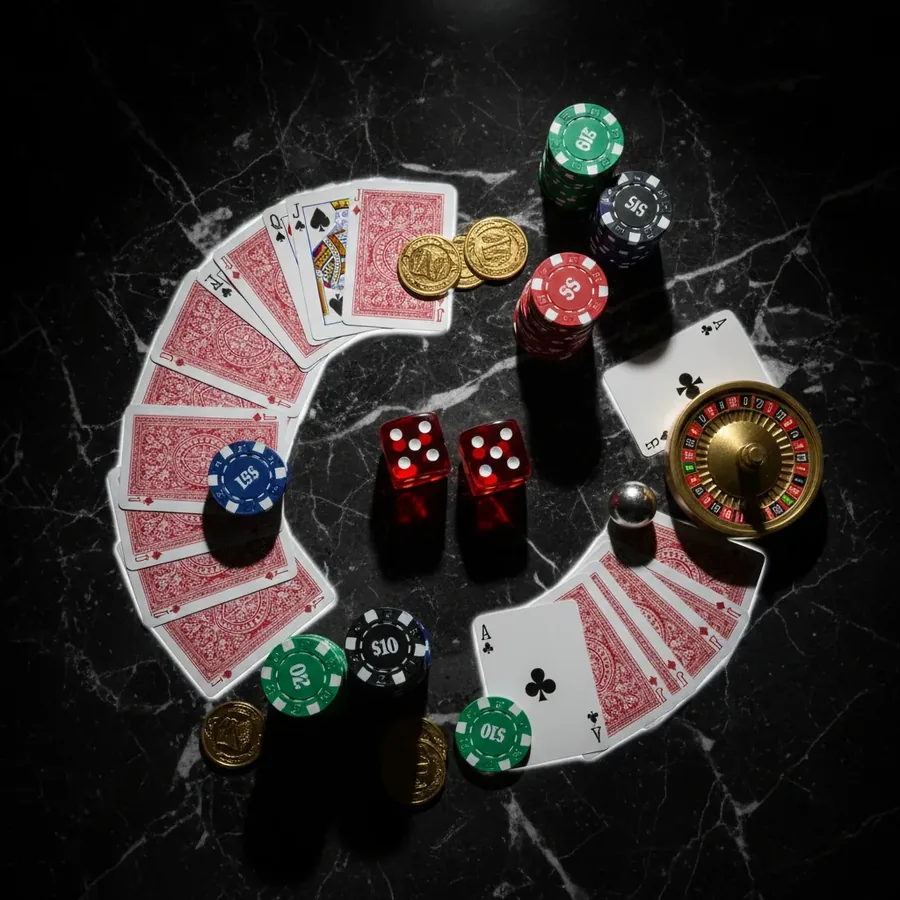
Before Doubling Down: Read the Dealer's Upcard
The dealer's open card is the parameter that decides whether doubling is worth the extra stake, and the blackjack rules show why: a dealer hitting soft 17 lowers RTP by 0.22 percentage points across the whole game. That single rule change is larger than resplitting aces at 0.08 percentage points and larger than doubling after a split at about 0.14 percentage points. Against a weak open card the extra card is drawn with the dealer still to act, so the player's €20 is committed before the dealer's hand resolves.
Deck count shifts the same calculation. A single-deck game with classic rules and a 3:2 payout returns 99.85% with a house edge of 0.15%, while one deck gives about −0.48 percentage points compared with 8 decks. A 6-deck game paying 6:5 instead of 3:2 returns 98.15% with a house edge of 1.85%, because replacing 3:2 with 6:5 adds exactly 1.39 percentage points to the casino's edge, more than any other rule change. The open card matters more when the base game is already thin.
Insurance is the clearest case of an open card driving a decision: when the dealer shows an ace, the side bet pays 2:1 but returns 92.53% with a house edge of 7.47%, and basic strategy always declines it except for card counters at a true count of +3 or higher. That is €7.47 lost per €100 staked on insurance over the long run. Reading the open card first keeps the doubled stake attached to the main hand, where the 6:5 payout of €12 on €10 still applies.
When to Surrender 16 Against a 10
A 16 against a dealer 10 is the classic surrender candidate, and the surrounding blackjack figures explain the pressure: a 6-deck game paying 6:5 returns 98.15% with a house edge of 1.85%, and the 6:5 payout alone adds exactly 1.39 percentage points to the casino's edge. On a €10 bet a blackjack pays €12 instead of €15, so the upside of standing on 16 is already reduced. Surrendering returns half the stake and ends the hand before the dealer draws.
The alternative is to play the hand out. Insurance, the side bet offered when the dealer shows an ace, returns 92.53% with a house edge of 7.47%, which is far worse than the 1.85% edge on the main 6:5 game, so taking insurance on a 16 against a 10 does not repair the position. Basic strategy declines insurance except for card counters at a true count of +3 or higher. The comparison leaves surrender as the cheaper exit on a hand that is already behind.
Deck count changes the threshold. A single-deck game with classic rules and a 3:2 payout returns 99.85% with a house edge of 0.15%, so the same 16 against a 10 costs far less to play out there than in the 6:5 six-deck game. One deck gives about −0.48 percentage points compared with 8 decks, and that difference is often offset by the weaker 6:5 payout. Surrender is therefore a decision tied to the specific table, not a fixed rule for every 16.
Straight-Up 35:1 Against 1-in-37 Odds
A straight-up bet on French roulette pays 35:1, and the wheel has 37 pockets, so the chance of any single number is 1 in 37. French roulette inside bets return 97.30% with a house edge of 2.70%, because La Partage and En Prison do not cover inside bets, which leaves the edge at the European level. A €10 straight-up bet returns €350 on a win, and the 2.70% edge costs €2.70 per €100 staked over the long run.
The American wheel is the contrast. Its five-number bet covering 0, 00, 1, 2 and 3 pays 6:1 and returns 92.11% with a house edge of 7.89%, the only bet on that wheel with an edge above 5.26%. That single wager covers 5 of 38 pockets, so the payout is far below the true odds. On the European wheel there is no equivalent, which keeps the straight-up bet at 35:1 with the same 2.70% edge.
Inside bets on French roulette follow the same pattern: a split pays 17:1, a street 11:1, a corner 8:1, a six line 5:1, and a dozen or column 2:1, all under the 2.70% house edge that applies because La Partage does not reach them. The straight-up 35:1 is therefore the highest-paying inside bet on the wheel, and the 1 in 37 chance is the figure that sets its value. Outside bets are the only place where the French rule changes the maths.
House Edge and RTP: Two Sides of the Same Number
House edge is the average share of each stake that the casino keeps, and RTP is its mirror: the two always add up to 100%. Craps Pass Line and Come return 98.59% with a house edge of 1.41%, and the same bet resolves at 0.42% per roll with a standard deviation of 1.00. That means €100 staked on the Pass Line costs €1.41 on average once the bet resolves, and the figure is not a forecast for a single session.
The extremes on the table make the pairing clear. Video Poker Deuces Wild in the Full Pay version returns 100.76% with a house edge of −0.76%, a positive expectation for the player that requires flawless optimal strategy and the maximum bet. Any deviation from that strategy pushes RTP below 100%. Sic Bo Small and Big, by contrast, return 97.22% with a house edge of 2.78%, and the overall Sic Bo edge runs from 2.78% to 33.33% depending on the bet.
Free Odds in craps is the only wager with a house edge of 0.00%, paying at true odds with an RTP of 100.00% on the odds portion; combined with a Pass Line bet in the 3-4-5x mode the figure is 99.63% with 0.37% on the pair. At 1x the combined per-roll edge is 0.251%, at 2x it is 0.180%, and at 3-4-5x it is 0.111%. The odds bet is available only on top of a Pass or Don't Pass wager once a point is set, which is why it cannot be played alone.
Game categories at a glance
| Category | Examples | Stakes From | Highlight |
|---|---|---|---|
| Slots | Money Train 3, Temple Tumble Megaways, Reactoonz | 0.10 EUR | thousands of titles |
| Table games | Roulette, Blackjack, Baccarat | 0.50 EUR | classic rules |
| Live casino | XXXtreme Lightning Roulette, Blackjack Party | 0.20 EUR | real dealers |
| Jackpot games | Mega Moolah, Divine Fortune, Age of the Gods | 0.20 EUR | progressive pools |
| Instant games | Aviator, Plinko, Mines | 0.10 EUR | fast rounds |
| Video poker | Jacks or Better, Deuces Wild | 0.25 EUR | strategy based |
Punto Banco: 5% Commission on Banker Wins
A winning Banker hand in Punto Banco is settled at 1:1, but the casino deducts a 5 percent commission from that payout. That reduction is the cost of backing the side with the lower built-in advantage. On a €10 win the commission takes €0.50, leaving €9.50 of profit.
The 5 percent commission is applied only to Banker wins, never to Player or Tie outcomes. Player continues to pay 1:1 with no deduction at all. The commission changes the effective return on the Banker stake and keeps the two main hands close together in long-run cost.
For a full session of 100 Banker wins at €10 each, the commission totals €50. A Player streak of the same size would return the full €1,000 of winnings. Choosing between the two sides therefore means comparing the Banker's better probability against that recurring 5 percent deduction.
The Player Bet Pays 1:1 With No Commission
The Player bet in Punto Banco pays 1:1 with no commission or fee deducted from the winning payout. A €25 wager returns €25 in profit. That makes the settlement simpler than the Banker side, where 5 percent is withheld from every winning hand.
Although Player pays a clean 1:1, the Banker hand still holds a lower natural probability of winning. The absence of commission does not change the underlying probabilities or the long-run cost of the main game. It only changes how the payout is calculated at the table.
A Player win of €100 returns €100 exactly, with nothing subtracted before the chips are paid. Over 50 such wins the total profit is €5,000. The straightforward payout removes one calculation step, but the mathematical edge on the main bet remains unchanged by that convenience.
Jacks or Better: Check Payout Table Before Betting
Jacks or Better 9/6 full pay returns 99.54% RTP with optimal strategy, meaning the casino keeps 0.46% as house edge. The label "9/6" refers to the payout of 9 for a Full House and 6 for a Flush per coin. Those two numbers are the quickest way to identify the full-pay version.
The Royal Flush pays 800 coins, but jumps to 4,000 only when the maximum bet of 5 coins is placed. A player betting fewer than five coins loses that bonus multiplier entirely. Standard deviation for the game is 4.42, which is high for a video poker variant.
Lower pay tables with a Flush at 5 or a Full House at 8 reduce the RTP below 99.54%. On 100,000 spins at €1 per hand, the theoretical cost of the full-pay table is €460 of total stakes. The same volume on a reduced table costs more, so the payout table must be checked before play begins.
Craps: Pass Line Plus Odds Lowers the Average Edge
The Craps Pass Line pays 1:1 and carries a house edge of 1.41% per resolved bet, or 0.42% per roll. Come has identical math. A €100 Pass Line stake therefore costs €1.41 on average by the time the point is resolved.
Free Odds are the only bet in the casino with zero house edge, paid at true odds. On a point of 4 or 10 the odds pay 2:1, on 5 or 9 they pay 3:2, and on 6 or 8 they pay 6:5. In 3-4-5x mode the combined Pass Line plus Odds edge drops to 0.37%.
The reduction from 1.41% on Pass Line alone to 0.37% with full 3-4-5x odds is the most significant edge cut available in the table. Per roll the combined edge falls to 0.111%. With 1x odds it is 0.251%, and with 2x odds it is 0.180%, showing the average cost falling as the odds wager grows.
Dozen Bets at 2:1: Twelve Numbers, a Third of the Wheel
A dozen bet covers 12 of the 37 or 38 pockets on a roulette wheel and pays 2:1, meaning a €10 stake returns €30 in total when one of those 12 numbers comes up. On a single-zero wheel the 12/37 share of pockets corresponds to a 32.43% chance of landing, so the 2:1 payout is the price the house pays for that coverage. The house edge on this bet stays at 2.70% on the European wheel and 5.26% on the American wheel.
Compare that with a straight bet on a single number, which pays 35:1 and covers just one pocket. The dozen's 12-pocket spread produces more frequent but smaller returns, while the straight bet's 35:1 payout arrives on 1 pocket in 37 or 38. The hit frequency difference is what separates the two wagers in a session.
A dozen bet placed 100 times at €10 each means €1,000 of stakes, and at a 2.70% edge the average cost is €27.00 on the European wheel. On the American wheel the same 100 bets at €10 carry an expected cost of €52.60 because of the extra double-zero pocket. Neither figure changes the 2:1 payout itself.
Splitting in Blackjack: One Hand Becomes Two
A split turns one starting hand into up to 4 hands, each played separately, and doubling after a split improves the return by about 0.14 percentage points. Resplitting aces improves the return by 0.08 percentage points. Both are rule modifiers rather than a fixed RTP, so they shift the edge attached to the base game.
Against a single-deck blackjack game at 99.85% RTP and a 0.15% house edge, those modifiers matter because the deck count itself already moves the edge. One deck gives about −0.48 percentage points compared with 8 decks. Blackjack pays 3:2 and a winning hand pays 1:1 on the stake.
When a hand is split, the player adds a second stake equal to the first, so a €10 hand becomes €20 at risk across 4 possible hands if resplitting is allowed. Split aces usually receive one card each, which limits how far the hand can be built. The dealer hitting soft 17 goes the other way, adding 0.22 percentage points to the house edge.
Roulette Wheels: 37 vs 38 Pockets
The European wheel carries 37 pockets and the American wheel carries 38, because the American version adds a double zero alongside the single zero. That single extra pocket lifts the house edge from 2.70% to 5.26% on the standard even-money bets. The payout table, however, is identical on both wheels.
On the American wheel the Five Number Bet covering 0, 00, 1, 2 and 3 returns 92.11% RTP with a 7.89% house edge, the only bet on that wheel above 5.26%. There is no equivalent bet on the European wheel, so the trap exists only where the double zero sits. A Five Number Bet pays 6:1 on 5 of 38 pockets.
French roulette keeps the same 37-pocket wheel as the European version, and inside bets there return 97.30% RTP with a 2.70% house edge because La Partage does not apply to them. A €10 straight bet on the French wheel therefore carries the same 2.70% edge as its European counterpart. The 37 versus 38 pocket split remains the single largest structural difference between the two wheels.
Straight, Split, and Corner: Three Terms Briefly Explained
A straight bet covers 1 number and pays 35:1, a split covers 2 adjacent numbers and pays 17:1, and a corner covers 4 numbers and pays 8:1. These three inside bets sit on the same 37-pocket European wheel, where each carries a 2.70% house edge. The payout falls as the coverage grows.
On the French wheel the same three bets return 97.30% RTP with a 2.70% house edge, because La Partage and En Prison do not extend to inside bets. The outside bets, by contrast, are where those rules apply on the French layout. The coverage-to-payout ratio is the constant that links all three.
At €10 per spin, a straight bet on one number costs €0.27 on average per spin at a 2.70% edge, a split costs the same, and a corner costs the same, because the edge is identical across them. Over 100 spins that is €27.00 of expected cost regardless of which of the three is chosen. Only the variance differs, not the edge.
American Roulette: 5.26% Because of the Double Zero
American roulette runs on 38 pockets and carries a 5.26% house edge on its standard bets, roughly double the 2.70% edge of the 37-pocket European wheel. The Five Number Bet on 0, 00, 1, 2 and 3 is the exception, returning 92.11% RTP with a 7.89% house edge. It is the only bet on the American wheel above 5.26%.
That Five Number Bet pays 6:1 while covering 5 of 38 pockets, and it has no equivalent on the European wheel. The gap between its 7.89% edge and the standard 5.26% edge is 2.63 percentage points, all of it concentrated on one wager. Players who avoid it still face the 5.26% base.
Staking €100 across standard American bets costs €5.26 on average, against €2.70 for the same stakes on the European wheel. The difference of €2.56 per €100 is the price of the double-zero pocket. Over 1,000 €1 spins, that gap widens to €25.60 in expected cost.
Contact
Live - online chat
Banking









Providers












Grizzly Casino 2026