
WELCOME BONUS 300%
UP TO €2000 + 100
FREE SPINS
UP TO €2000 + 100
FREE SPINS
Home → Roulette
Roulette at Grizzly Casino: rules, odds and strategy
2.70 vs 5.26 Percent House Edge
The house edge is the share of each stake the casino keeps on average over the long run, and Roulette European carries 2.70% against 5.26% on Roulette American. That gap comes from the wheel itself: 37 pockets on the single-zero wheel versus 38 pockets on the double-zero wheel, while payouts stay identical on both. On €100 of stakes, the European wheel costs €2.70 and the American wheel €5.26.
Across all 37 pockets of Roulette European, every bet returns the same 97.30% RTP because payouts are set as if there were 36 pockets. Roulette American pays the same odds but the extra pocket pushes RTP down to 94.74%. The straight bet pays 35:1 on both wheels, so the difference sits entirely in the extra pocket rather than in the payout table.
The one exception on the American layout is the Five Number Bet on 0, 00, 1, 2 and 3, which covers 5 of 38 pockets at 6:1 and returns 92.11% RTP with a 7.89% house edge. That is the only American bet above 5.26%. On the European wheel no equivalent bet exists, so no wager there carries an edge above 2.70%.
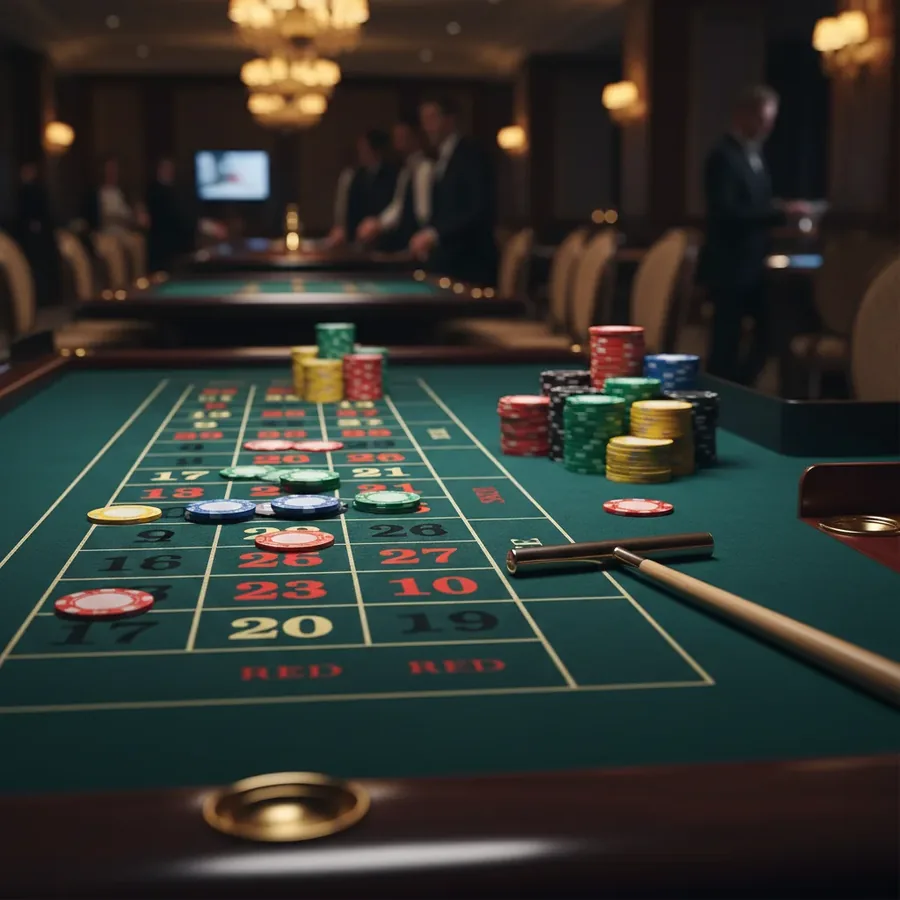
Mistake: Counting on a 500x Multiplier
Quantum Roulette Live from Playtech assigns Quantum multipliers of up to x500 to between 1 and 5 numbers on a 37-pocket wheel, and it runs at 97.30% RTP. The maximum applies to a narrow set of numbers in a single round, not to the wheel as a whole. A plan built around x500 treats a rare outcome as the normal case.
The base RTP is 97.30%. Cutting the straight payout while adding multipliers shifts value into the multiplier event instead of the base bet.
PowerUP Roulette, also from Pragmatic Play Live, uses 3 to 5 PowerUP numbers and shows a maximum win of up to x15,525, with RTP at 97.19%. Standard payouts on the same table remain straight 35:1, split 17:1, street 11:1, corner 8:1, dozen 2:1 and 1:1 on even-money bets. A multiplier-led plan therefore sits on top of a 97.19% base, not in place of it.
Even-Money Bets vs Straight-Up: Variance Compared
A straight bet on Roulette European pays 35:1, while red or black, odd or even and 1-18 or 19-36 pay 1:1. Both carry the same 2.70% house edge because the wheel has 37 pockets and the payouts are built for 36. Equal edge does not mean equal ride: the two bets distribute results very differently.
On a €1 straight bet, a single hit returns €35, and the bet covers 1 of 37 pockets. A €1 even-money bet covers 18 of 37 pockets and returns €1 on a hit. Over 100 rounds at €1 each, the expected cost is €2.70 either way, but the straight bet produces long runs of losses between hits.
The €2,000 upper end of the Mega Roulette bet range illustrates the same split in absolute terms: a straight bet there can return €70,000 at 35:1, while the same amount on an even-money bet returns €2,000. Six Line at 5:1 and Dozen at 2:1 sit between the two extremes. The 29:1 straight-up pay on that table reduces the top return to €58,000.
La Partage: What 50 Percent Return Means
La Partage applies to Roulette French and returns half the stake on even-money bets when 0 lands, covering red or black, odd or even and low or high. That rule lifts RTP on those bets to 98.65% and cuts the house edge to 1.35%. On a €10 even-money bet, a zero returns €5 instead of nothing.
The same 1.35% edge is reached through En Prison, which holds the even-money stake for the next spin instead of returning half of it. Either way, the benefit is limited to the 1:1 bets. Inside bets receive no part of the return, so a straight bet at 35:1, a split at 17:1, a street at 11:1 or a corner at 8:1 keeps the European 2.70% edge.
That split creates two different prices on one table. A player staking €100 across even-money bets faces an expected cost of €1.35, while the same €100 on inside bets costs €2.70. The 0 pocket is the trigger for both figures, and it is also the pocket the 50% return is built around.
Betting Too High on a 50 EUR Bankroll
Quantum Roulette Live from Playtech opens at €0.10 and runs to €5,000 per bet, while Mega Roulette and PowerUP Roulette from Pragmatic Play Live both span €0.20 to €2,000. On a €50 bankroll, the €2,000 and €5,000 ceilings are far out of reach, but the €0.10 and €0.20 floors keep every table playable.
Stake sizing shows the gap in rounds. At €0.10 a spin, €50 covers 500 spins; at €0.20 it covers 250. At the other end, one €5,000 bet on Quantum Roulette Live is 100 times the entire bankroll. The usable part of each range sits at the bottom, not the top.
The welcome offer adds €2,000 at 300% on a €2,000 deposit. A €50 deposit yields 50 € x 300% = 150 € bonus, giving a 50 € + 150 € = 200 € balance, plus 100 free spins. That stretches the same €0.10 floor to 2,000 spins, though the ceiling figures still demand far more than the balance holds.
Roulette bet types at a glance
| Bet | Payout | Win Chance | Numbers Covered | House Edge |
|---|---|---|---|---|
| Straight Up | 35:1 | 2.70% | 1 | 2.70% |
| Corner | 8:1 | 10.81% | 4 | 2.70% |
| Six Line | 5:1 | 16.22% | 6 | 2.70% |
| Dozen | 2:1 | 32.43% | 12 | 2.70% |
| Even / Odd | 1:1 | 48.65% | 18 | 2.70% |
| 1-18 / 19-36 | 1:1 | 48.65% | 18 | 2.70% |
| Five Number (0, 00, 1, 2, 3) | 6:1 | 13.16% | 5 | 7.89% |
A 100 Euro Bankroll: 100 Rounds on Even-Money Bets
On a European wheel, an even-money bet such as Red/Black pays 1:1, so a 100 € bankroll spread across 100 rounds of 1 € each is the comparison that matters for a player testing the single-zero layout. The house edge on that layout is 2.70%, which means 100 € of stakes cost 2.70 € on average over the long run. In other words, the expected return after those 100 rounds is roughly 97.30 €, not 100 €, and the 1:1 payout does not change that arithmetic.
Roulette French with La Partage lowers the cost of the same 100 rounds when only even-money bets are used, because its RTP is 98.65% and its house edge is 1.35%. That is exactly half the 2.70% taken by the European wheel on the identical 1:1 bets, since the rule returns half the stake when 0 hits. Over 100 € of even-money stakes, the average cost falls from 2.70 € to 1.35 €, a difference of 1.35 €.
The catch is that La Partage applies only to Red/Black, Odd/Even and Low/High, so the cheaper 1.35% edge does not extend to inside bets. A straight bet on the same French wheel keeps the European 2.70% edge, and the 100-round experiment therefore splits into two costs: 1.35 € per 100 € on even-money bets and 2.70 € per 100 € on inside bets. Which bet type is used decides the outcome more than the bankroll size.
What Budget Can Absorb a 2.70% House Edge
The 2.70% house edge on Roulette European comes from a 37-pocket wheel paying as if there were 36 pockets, so every bet on that layout carries the same theoretical cost per euro staked. On a 200 € budget staked at 1 € per round, the expected loss is 200 € x 2.70% = 5.40 € across 200 rounds. That is the average, not a cap, and short sessions can stray far from it in either direction.
Roulette American is the harder test of the same budget, because its 38 pockets and double zero push the house edge to 5.26%. Over the same 200 € staked at 1 € per round, the expected cost rises to 200 € x 5.26% = 10.52 €, or 5.12 € more than the European layout. A player choosing the double-zero wheel therefore needs almost twice the cushion for the same number of rounds.
The Five Number Bet on the American wheel is the extreme case, with a house edge of 7.89% and an RTP of 92.11%, the only bet above 5.26% on that wheel. Staking 200 € on that single combination implies 200 € x 7.89% = 15.78 € in expected cost. No equivalent bet exists on the European wheel, where the worst edge stays at 2.70%.
How Payout Odds 35:1 Are Achieved
A straight bet pays 35:1 because the payout is set as if the wheel had 36 pockets, even though the European wheel has 37. One winning number returns 35 units plus the original stake, so a 1 € straight bet collects 36 € in total. The missing 37th pocket is where the 2.70% house edge lives.
The same 36-pocket arithmetic repeats across the inside bets: a split pays 17:1, a street 11:1, a corner 8:1, a six line 5:1, and a dozen or column pays 2:1. On Roulette American, the identical 35:1, 17:1, 11:1 and 8:1 odds apply, but the extra double zero lifts the house edge to 5.26%. The payout scale does not change, only the pocket count behind it.
On Roulette French, the 35:1 straight payout and the other inside odds are unchanged, and La Partage does not apply to them, so those bets keep the 2.70% edge. The 98.65% RTP and 1.35% edge belong only to even-money bets such as Red/Black or Odd/Even. A 1 € straight bet on the French wheel therefore returns the same 36 € total as on the European wheel, with no La Partage rebate.
Multipliers up to 500x Lower the Base Payout
Quantum Roulette Live from Playtech runs on 37 pockets with a 97.30% RTP, and its Quantum multipliers reach up to 500x on one to five numbers. The base straight payout on that table remains 35:1, so the multiplier is an overlay added on top of the standard return rather than a replacement for it. A 1 € straight bet on a Quantum number can therefore collect the 35:1 base plus the assigned multiplier.
The lower base return is the price of the multiplier overlay, and the table keeps a 97.30% RTP overall. A 1 € straight bet on a Mega number therefore starts from a smaller base than on the European wheel.
PowerUP Roulette, also from Pragmatic Play Live, carries a 97.19% RTP with three to five PowerUP numbers and a maximum win of up to 15,525x. That RTP sits slightly below the 97.30% of Quantum Roulette Live and Mega Roulette. The bet range on PowerUP Roulette is 0.20 € - 2,000 €, and on Quantum Roulette Live it is 0.10 € - 5,000 €, so the two tables differ at both ends of the stake scale.
The 500x Multiplier Applies Only to Straight-Up Bets
The 500x ceiling on Quantum Roulette Live is tied to straight bets on one to five selected numbers, not to splits, streets, corners or dozens. A 1 € straight bet on a Quantum number with the full 500x applied returns 500 € from the multiplier plus the 35:1 base, whereas the same 1 € on a split pays 17:1 and receives no multiplier. The overlay is therefore narrow by design.
On PowerUP Roulette the multiplier applies to three to five PowerUP numbers, again on straight coverage, with a maximum win of up to 15,525x and a 97.19% RTP. The standard inside payouts stay in place elsewhere on the layout: 35:1 straight, 17:1 split, 11:1 street, 8:1 corner and 2:1 dozen. A 1 € wager on any of those non-PowerUP positions collects only the base return.
How Much Balance Covers 50 Rounds?
Quantum Roulette Live from Playtech opens at a minimum bet of 0.10 € per round. At that lowest limit, 50 rounds require only 5.00 € of balance, which is the smallest live-table entry cost in the comparison. A player who stays on the 0.10 € minimum can therefore test 50 spins without committing a larger deposit.
Mega Roulette by Pragmatic Play Live starts at 0.20 € per spin, so 50 rounds cost 10.00 €. That is exactly double the Quantum Roulette Live minimum and still below the PowerUP Roulette minimum of 0.20 €, which also works out to 10.00 € for 50 rounds. The two Pragmatic Play Live tables share the same lower boundary.
At the top of the posted range, a 5,000 € maximum bet on Quantum Roulette Live turns 50 rounds into 250,000 € of turnover. The two Pragmatic Play Live roulette games cap at 2,000 €, or 100,000 € over 50 spins. The spread between 5.00 € and 250,000 € shows how much the balance requirement depends on the chosen table and bet size.
What Outside Bets with 1:1 Actually Pay
Red/Black, Odd/Even and 1-18/19-36 pay 1:1 on the European wheel with its 37 pockets and 2.70% house edge. A 10 € stake returns 10 € in profit plus the original 10 € stake, so the player receives 20 € in total. The same 1:1 payout applies to Dozen and Column bets, but those cover 12 numbers and pay 2:1 instead.
French roulette with La Partage changes the 1:1 bets on a zero. When 0 hits, half of an even-money stake is returned, cutting the house edge on those bets from 2.70% to 1.35%. That means a 10 € Red/Black wager returns 5 € on a zero spin instead of losing the full amount, while inside bets keep the 2.70% edge.
On the American wheel, the same 1:1 outside bets carry a 5.26% house edge because the extra double-zero pocket doubles the casino advantage. A 100 € total on Red/Black costs 5.26 € on average over the long run, against 2.70 € on the European wheel. La Partage does not exist on the American table, so no half-return applies.
Mistake: Picking the American Wheel at 5.26%
Roulette American runs on a 38-pocket wheel with 0 and 00, producing a 5.26% house edge. That is nearly double the 2.70% edge of Roulette European on its 37-pocket wheel. For every 100 € staked, the American wheel keeps 5.26 € on average, against 2.70 € on the European wheel.
The Five Number Bet on 0, 00, 1, 2 and 3 is the worst choice on the American layout, with a 7.89% house edge and a 92.11% RTP. It pays 6:1 but covers only 5 of 38 pockets, so the extra pocket pushes the edge above the standard 5.26%. No equivalent bet exists on the European wheel.
A player switching from French roulette with La Partage to the American wheel triples the disadvantage on even-money bets, moving from a 1.35% edge to 5.26%. On 100 € of outside bets, the expected long-run cost rises from 1.35 € to 5.26 €. The American table is therefore the weakest roulette option in the comparison.
The American Wheel: 38 Pockets, 94.74%
Roulette American uses 38 pockets numbered 1 to 36 plus 0 and 00, giving an RTP of 94.74%. Straight bets pay 35:1, Split 17:1, Street 11:1, Corner 8:1, Six Line 5:1, Dozen 2:1, Column 2:1 and Red/Black 1:1, but every payout is calculated as if only 36 pockets existed.
The 94.74% RTP is the lowest standard roulette return in the group, below the 97.30% of Roulette European and the 98.65% of French roulette with La Partage on even-money bets. Over 1,000 € of wagers, the American wheel returns 947.40 € on average, while the European wheel returns 973.00 €.
The extra double-zero pocket is the entire reason for the gap. With 38 pockets instead of 37, the chance of a single number hitting is 1 in 38 rather than 1 in 37, yet the straight payout remains 35:1. That mismatch produces the 5.26% house edge and turns the double zero into a permanent cost for every bet placed.
Why the Ball Has No Memory
A roulette wheel does not track previous results, so a red number appearing ten times in a row does not make black more likely on the next spin. On a 37-pocket European wheel, the probability of Red stays 18 in 37 every round, and the probability of any single number stays 1 in 37. The house edge of 2.70% is unchanged by past outcomes.
The 38-pocket American wheel shows the same principle with a fixed 5.26% edge. After five straight numbers in a row, the chance of the next number being a repeat is still 1 in 38, not lower. Quantum Roulette Live, Mega Roulette and PowerUP Roulette all keep their posted RTP values regardless of the sequence that has just appeared.
A player who raises a bet after a losing streak is not improving the odds, only increasing the amount exposed to the same 2.70% or 5.26% edge. Over 100 € of fresh stakes after a loss, the expected cost remains 2.70 € on the European wheel and 5.26 € on the American wheel. No betting pattern can alter the fixed payout ratios.
Contact
Live - online chat
Banking









Providers












Grizzly Casino 2026